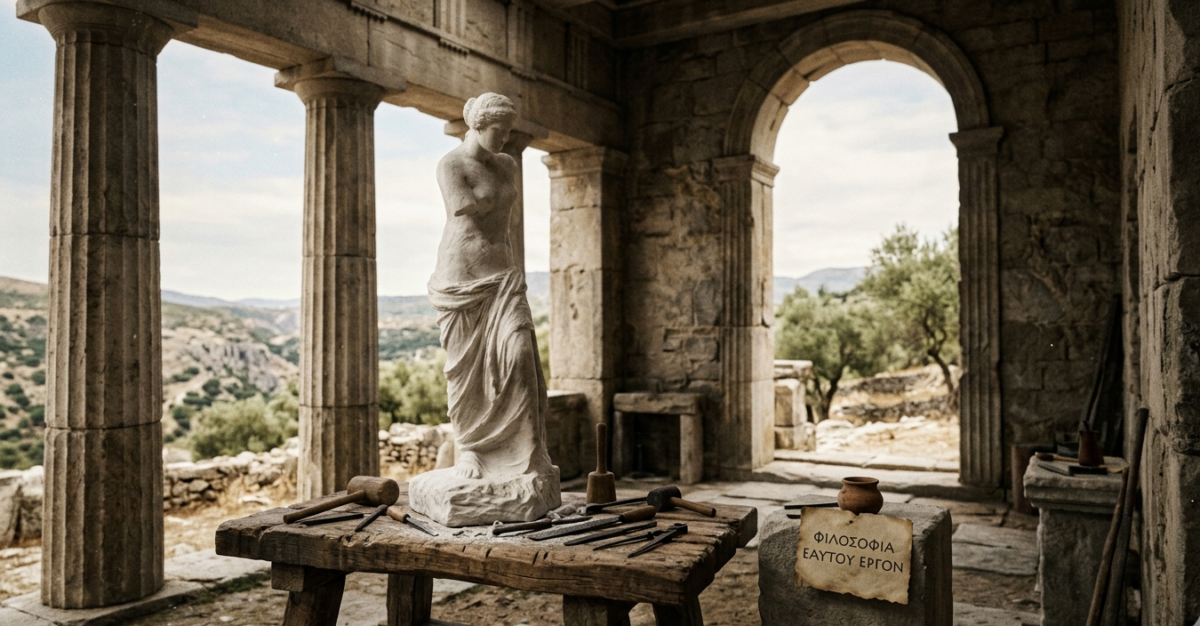
I recently came across a fascinating essay by Inna Sevelius in Modern Filosofi that tracks the "red thread" of human self-improvement. It got me thinking about how our modern obsession with "finding ourselves" is actually rooted in ancient practices that were much more rigorous than today's surface-level self-help.
At the entrance of the Temple of Apollo at Delphi, the famous inscription "Know Thyself" served as a foundational pillar of Western thought. But as Michel Foucault pointed out, in antiquity, this motto was never a standalone intellectual exercise—it was inseparable from the rule of self-care.
To truly "know" oneself was to actively "care" for oneself. This wasn't the modern concept of self-care involving comfort; it was askesis—a rigorous training of the self, by the self, in order to master the science of living.
The Stoic Practice of Reflection
Sevelius highlights how, in the Greco-Roman philosophy of the Stoics, writing became a primary tool for self-improvement. Seneca didn't write to others just to communicate; he wrote to himself to practice living a different life.
At the end of each day, he would review his actions, comparing his behavior against the moral rules he aimed to follow. He sought to live "under the gaze of another," with nothing to hide. This forensic interest in the "unimportant" details of daily life creates a direct historical line to the free association used in modern psychoanalysis.
From Stoic Control to Christian Confession
While the Stoics practiced self-reflection to gain self-control, the early Christian tradition shifted the focus toward confession.
Under the guidance of figures like Cassianus, the goal was to root out hidden desires. The method was simple yet profound: you must put everything into words. By confessing every thought to a master or superior, the believer was thought to be liberated from the illusions of the self.
The Bridge to Psychoanalysis
It is fascinating to see how closely these ancient and medieval techniques mirror the "talking cure."
- The Stoics gave us the habit of constant self-scrutiny.
- The Christians gave us the belief that truth is found by speaking the unspoken to an authority figure.
- Psychoanalysis combined these, suggesting that when a person can say everything to an analyst—when nothing is left secret—the process is complete.
In both the monastery and the clinic, the act of formulation is the moment of truth. However, as we move into the modern era, the goal of this "project of the self" has shifted from denying the self to "creating" it—a topic I’ll explore in my next post.
Source: Sevelius, I. (2015). "Jaget som projekt." Modern Filosofi, #2, pp. 54–59.


0 Comments